

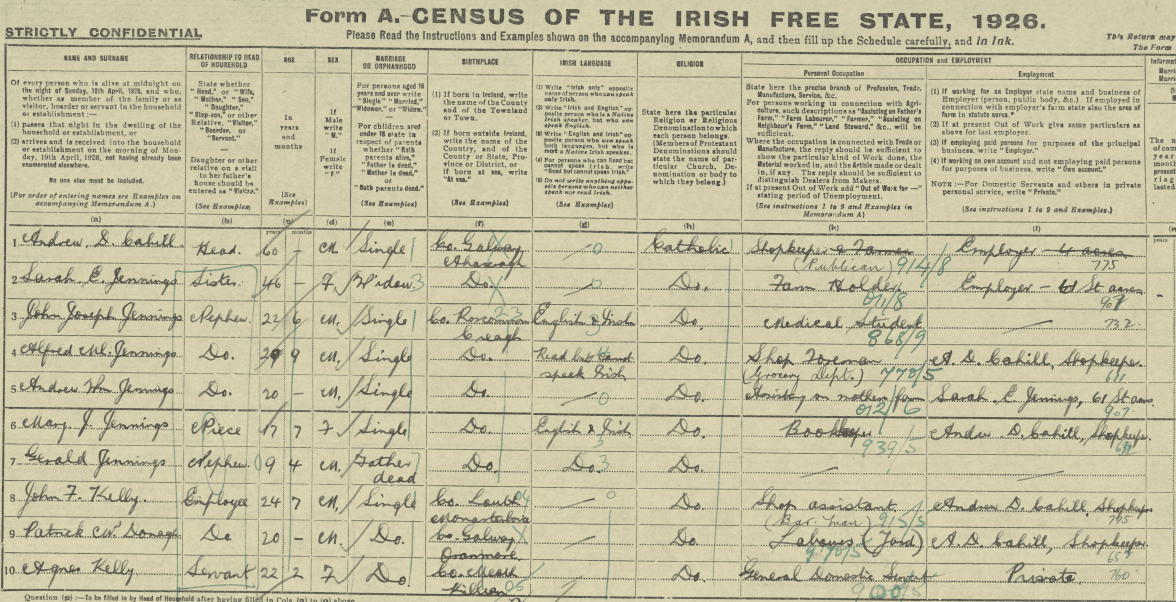
(Photo: 1926 census return showing the author’s Jennings and Cahill ancestors on Society Street)
For family history enthusiasts, last month’s release of the 1926 Census – made available exactly 100 years after it was taken – has provided hours of fascination. Offering a unique snapshot of life in Ireland a century ago, the records allow people to trace ancestors, uncover forgotten stories and, in some cases, reconnect with long-lost branches of their family tree.
The 1926 Census, the first undertaken by the fledgling Irish state, differs significantly from the earlier 1901 and 1911 censuses, particularly in the level of detail it recorded. Alongside the usual questions on name, age and occupation, enumerators also asked for a person’s place of birth down to townland or town level, the name of their employer and the total acreage of agricultural holdings. For many family researchers, these additional details have helped break through long-standing “brick walls” in their genealogy research.
Turning from individual family stories to our own locality, what picture does the 1926 Census paint of Ballinasloe?
The population of Ballinasloe Urban area stood at 5,249 on census night – a slight increase from the 1911 figure of 5,195 and 6.4% higher than in 1901.
One notable feature of the census was a significant gender imbalance, with women accounting for just over 40% of the town’s population.
Just over one in every eight residents lived in the town’s lanes, many of which branched off the main streets. Interestingly, the lane population of 697 people was exactly the same as that recorded in 1911. Within a decade many of these lanes had been emptied as new housing estates were built, meaning the 1926 Census likely represents the final detailed record of the lanes and their people.
In religious terms, Ballinasloe was overwhelmingly Catholic, accounting for 96.5% of the population. The remainder comprised 138 Church of Ireland members, 35 Presbyterians, 11 Methodists and one Christian Scientist – an Australian-born commercial traveller. One of the most striking demographic changes revealed by the census is the sharp decline in the town’s Protestant population, which fell by 65% from 515 people in 1901 to 185 in 1926 (these figures come from the published 1926 Census returns, which do not correspond to those on the 1926 Census page).
Another remarkable finding concerns the town’s largest institution: St Brigid’s Hospital. On census night, the institution – then known as Ballinasloe District Lunatic Asylum – accounted for almost one-third of the town’s entire population. The census recorded 1,002 males and 733 females living there, a total of 1,735 people including patients and resident staff. Those returns also reveal that this population lived across 810 rooms.
Unlike the 1901 and 1911 censuses, which identified hospital patients only by initials, the 1926 records provide their full names, opening another avenue for family historians.
The census also provides details of St Joseph’s Industrial School, commonly known as the Convent Orphanage. It recorded 84 girls aged between six and twenty years.
Meanwhile, recently established in Garbally Park, St Joseph’s College had 121 residents on census night, including six priests, two teachers, six farm workers, 13 servants and 94 students. Its census return is particularly distinctive because it was completed entirely in Irish, although the transcription by the National Archives unfortunately contains errors. Have you found your family yet? Search at https:// nationalarchives.ie/collections/search-the-1926-census/.