

Ancient apple trees are a living connection to the past and our heritage. However, for a variety of reasons trees are vulnerable and can die from old age, storms, or human activities, and their varieties can be lost to us.
Clontuskert Heritage Group set up the “Clontuskert Orchard Mapping Project” in spring 2026 to locate, map, document and graft ancient samples of apple trees from the oldest surviving nineteenth century orchards in Clontuskert and its surrounding region. Young grafted trees will then contribute to the creation of a community conservation orchard, which will preserve the varieties for the future. The project will also celebrate local varieties, their history, and stories.
The project was founded for a range of reasons. In many cases, the trees are the last living connection to families who may have emigrated, and often the knowledge and history of those trees have been lost to time. We are also at a turning point where these trees are still surviving, and it’s a collective responsibility to locate them, preserve and propagate them for future generations so they can live another 150 years.
The Group contacted Heritage apple conservationist Cillian Boyd to initiate the orchard mapping project. Cillian surveyed Ordinance Survey of Ireland maps from the 1840’s and compared them against later maps and satellite imagery to locate surviving orchards and trees. He then pinned a selection of places on Google maps and shared the locations with the group so that they could inquire in advance of Cillian visiting.
Quite a number of places had trees. Other places were located by the group through their local contacts. It has been a successful collaboration because the Heritage Group has done a huge amount of research and possesses local knowledge, allowing them to connect with locals who hold “intangible cultural heritage” – knowledge that is not written down but shared through conversation.
One of the most fascinating discoveries made by the heritage group was of a gardening diary dated from the 1860’s of Bernard McLoughlin, the Head Gardener at Somerset House, Clontuskert. The diary recorded details of daily gardening activities, local workers, and the jobs they undertook. Bernard’s home place was nearby in Coolbeg.
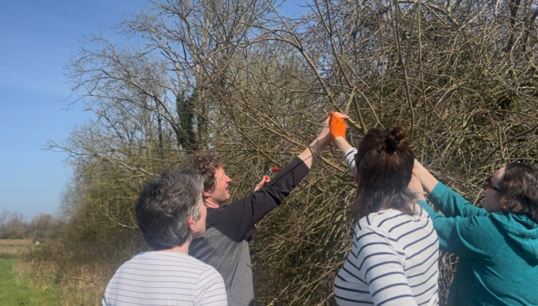
Cillian recounts: “I visited Coolbeg and met his great grand-daughter Sheila. There were about five trees at Coolbeg. The trees were some of the oldest I’ve ever seen, easily over 120 years old, and free from disease. We visited a selection of ancient orchards, collected scion (cuttings) and grafted 30 trees or so from the locality”.